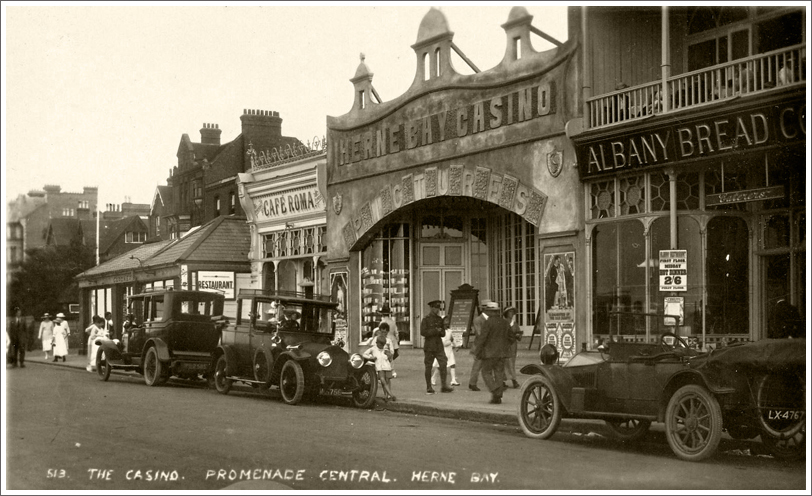
Herne Bay’s coastal location and proximity to the conurbation of Canterbury contributed to its development as a resort and town which was relatively recent compared with some of its other East Kent neighbours. Charles Seymour writing in 1776 mentions sea bathing at Herne Bay as well as the availability of accommodation for families and regular visits of coastal trading vessels and colliers from Sunderland and Newcastle had long been established for offloading cargoes to Canterbury and other East Kent towns and villages. By 1792 bathing machines were being introduced on this part of the coast just east of The Ship which must have started to increase the number of visitors who were coming for recreational reasons rather than just commercial and trading. A military encampment was established at the base of The Downs in 1799 as part of the coastal defence precautions against the French which in turn must have increased awareness of the availability of pleasant residential opportunities So it was that in the area of The Ship Inn houses started to be constructed about 1816. The main catalyst for this was the formation of the Turnpike Trust formed by Act of Parliament in 1814. The road from the shore to Canterbury was well established but it was subject to a considerable amount of traffic and its maintenance and up keep presented difficulties. Local land owner Sir Henry Oxenden who owned much of the land west of The Ship along with others formed the Trust as a means of raising revenue for the improvement of the road. The turnpike had two bars: one at Sweechgate Broad Oak and one at the junction of Mickleburgh Hill and Canterbury Road at the Herne Bay end. It followed the line of the modern Canterbury Road before turning west along Mortimer Street heading down the hill to the shore adjacent to The Ship which was a convenient location close to the shore and the busy landing point for shipping. Several engravings of 1823 show the landing area on the beach and the early development of the town centred on The Ship.
An early plan view of the proposed street layout for Herne Bay from Capper’s Guide book 1833 illustrates how the early settlement of houses were still cantered around the Ship and the extent of “The Old Town” This part of Herne Bay developed steadily and a measure of its success can be gauged from the fact that the number or residents and visitors were such that they were able to support shops, a flour mill, a post office and a bakery. People's spiritual needs were also accommodated when Joseph Hanson, a Londoner, established a chapel in the area for nonconformists. Herne Bay continues to be mentioned,usually in favourable terms, in the travel guides of the day and a typical example is provided by Frances Coghlan writing in 1834. He states that “Herne Bay has for many years been a select retreat for sea bathing; the line of the shore possessing peculiar advantages as a watering place standing on an easy elevation,commanding a most delightful view of the ocean, without any accumulation of mud from the flow of the tide”.